
Networks for XR
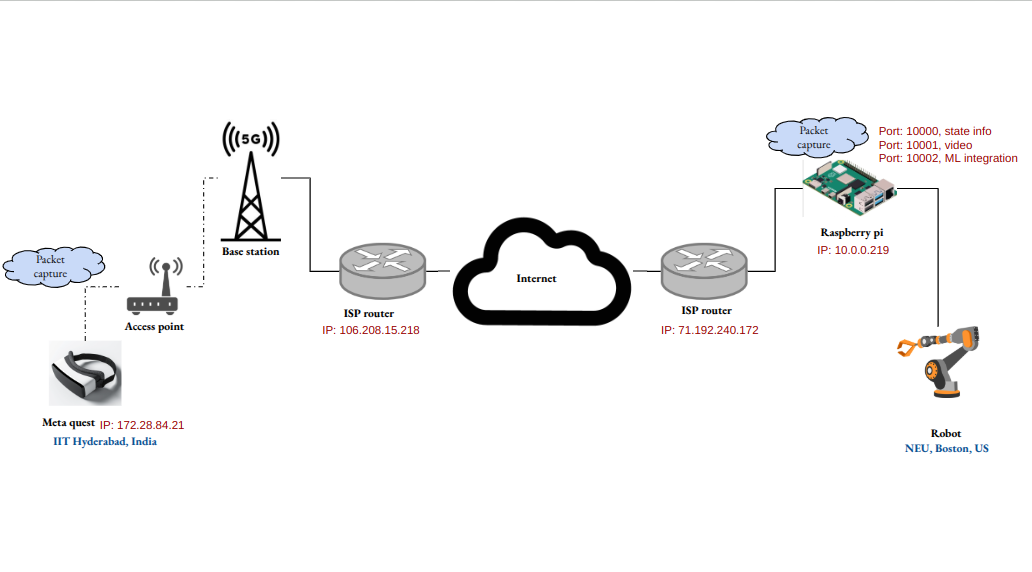
Overview
Details
Network-Aware Teleoperation Systems
Teleoperation has evolved from traditional master–slave robotic control into immersive, multi-modal multi-lateral systems powered by Extended Reality (XR), 5G/6G networks, and edge computing. Modern teleoperation platforms combine high-definition video, haptic feedback, control signals, and digital twin state synchronization, forming heterogeneous data streams with stringent latency, reliability, and freshness requirements.
Our research addresses the fundamental challenge of designing network-aware teleoperation architectures that go beyond classical delay-based control models. We investigate how network-layer phenomena such as queuing dynamics, congestion control, scheduling policies, wireless variability, and long-haul routing paths impact stability, transparency, and perceptual performance in XR systems.
Key Research Directions
- Ultra-Low-Latency Networking for Control/Haptic Interaction: Modeling and minimizing end-to-end latency and jitter for stable bilateral control and haptic information.
- Age-of-Information (AoI) and Digital Twin Synchronization: Designing freshness-aware update mechanisms to ensure consistent remote state representation.
- Edge and MEC-Assisted Teleoperation: Leveraging edge computing for predictive control, local rendering, and AI-driven compensation.
- Cross-Layer Teleoperation Design: Integrating control, communication, and computation perspectives for end-to-end system optimization.
- Transport and Congestion Control for Real-Time Robotics: Investigating protocol adaptations for reliable and responsive teleoperation over shared networks.
- QoS, Network Slicing, and Deterministic Networking: Enabling prioritized multi-modal traffic delivery for scalable XR telepresence systems.
| Research Problem | Description |
|---|---|
| Systematic Evaluation of Existing Network Services for Teleoperation Systems | Conduct a comprehensive analysis of current network services supporting teleoperation systems, identifying their limitations meeting strict requirements such as low latency, high reliability, and consistent performance, and exploring open research challenges and future directions. |
| Transport Layer Protocols for teleop | Evaluate and compare transport layer protocols to determine their suitability for teleoperation using measurement-driven studies under real-world network conditions. |
Research Scholars
Donkana Sai Keerthana, Debdip Choudhuri, Rathan Appana, Chalasani Vineeth, Rushikeshwar Reddy
Related
Active Grants
Synergy: Taking openness to the next level in 6G Networks
Department of Science and Technology, Govt. of India
PI: Antony Franklin
Information Security Education Awareness (ISEA) Phase III
MeitY
PI: Antony Franklin